
Inside the pilot behind Ortovox's RE:volution shirt
In July 2026, our brand partner Ortovox launched the RE:volution Shirt, made from 100% textile-to-textile recycled polyester, sourced from post-consumer European textile waste and entirely manufactured in Europe. It originated from our collaborative work spearheaded by Accelerating Circularity, and Ortovox designed it with circularity and recyclability in mind. Now, let’s go back in time and share how it came to life.

Image: Ortovox
From vision to reality
In 2022, Accelerating Circularity launched system trials for polyester-based textile recycling in Europe, convening 28 companies — from textile collectors, sorters, and recyclers (both thermo-mechanical and chemical) to yarn spinning, knitting, weaving, and garment manufacturing companies, as well as outdoor brands — to build and stress-test five polyester supply chains. We followed a structured, three-phase methodology: Research & Mapping to identify end users and supply chain partners, Modeling & Linking to form working groups and align on parameters, targets, and timelines, and Piloting to validate sorting, reprocessing, recycling, and spinning capabilities at commercial quality.
One of those five supply chains produced a tangible result: our brand partner Ortovox has launched the RE:volution Shirt, made from 100% textile-to-textile recycled polyester sourced from post-consumer European textile waste and entirely manufactured in Europe, designed with circularity and recyclability in mind.
Our story of feedstock
Mind you, the pilot began in 2022, during the early days of circularity. So, how did we start?
We wanted to keep it simple. For the first pilot run with CuRe Technology, we focused on pure PET bedding feedstocks from duvets and pillows. We ordered 500 kgs of post-consumer 100% PET bedding from our collecting and sorting partner TEXAID, then ran it through TOMRA's automated sorting technology at their test center in Germany to confirm the composition.

Image: Ortovox
What was intended as a confirmation of a 100% PET composition turned into a 78% rejection rate.
Our test report explained why: duvets combine fillings and outer shells of various fibers, are often glued together, and frequently arrive at sorting facilities still in their covers, which may be yet another material. Compositions also varied by region, and even "pillows" ranged from decades-old bed pillows to plush, embroidered, sequined decorative ones. Hence the high rejection rate — simple doesn't always mean easy.
The second feedstock fraction was — lovingly called by our stakeholders — the "wild mix" of post-consumer polyester textiles sourced from our pilot partners TEXAID and Erdotex. As non-reusable textiles often still have trims, the feedstock was first pre-cut in a guillotining process and then run through the automated Trimclean equipment from Valvan. Clippings with zippers, buttons, elastic cords, or similar were sorted out through the process.
Finally, we added a third fraction: post-consumer mattresses, successfully processed by CuRe Technology. Their molecular recycling offers a low-energy solution for polyester. A peer reviewed LCA from 2023 showed that producing textile-grade PET from post-consumer feedstock processed at CuRe Technology’s location in the Netherlands, using renewable energy, resulted in a carbon footprint >85% lower than that of virgin PET production*. Recycling polyester textiles also reduces waste volumes and avoids virgin polyester production from fossil fuels.
Back to the pilot: The polymer was sent to our partner Antex in Spain for extrusion and texturizing, with no major issues experienced. Next, the 78dtex/68f yarn moved on to A.Sampaio, Portugal for knitting. Knitting proceeded without issues, performing just like any other yarn according to our partner A.Sampaio. The resulting 140 gsm interlock fabric passed all physical and mechanical test requirements. It was also tested for chemicals according to the AFIRM RSL Testing Matrix 2022, with no detections.
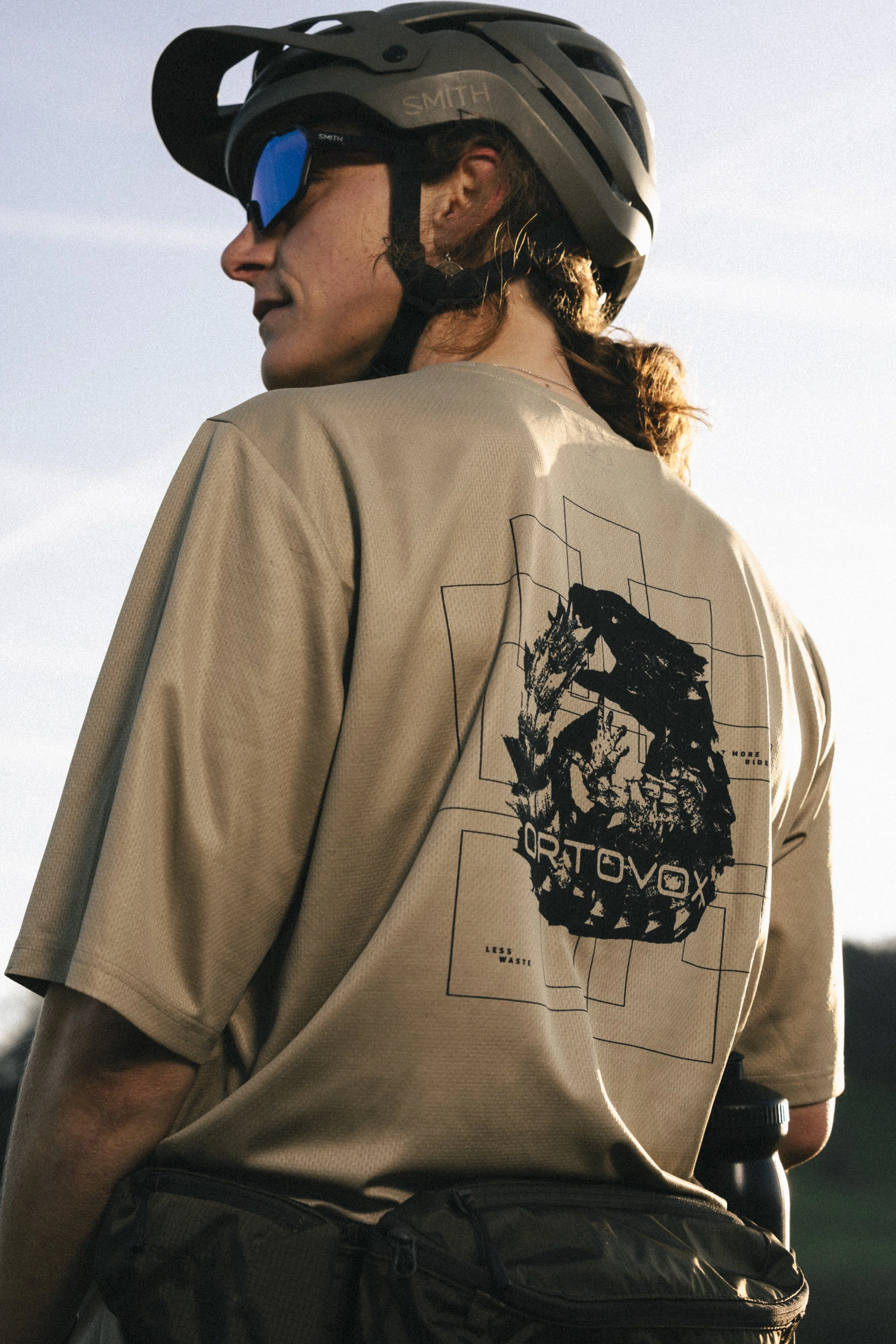
Image: Ortovox
A.Sampaio also offered to knit three fabrics on the same machine and setup using virgin polyester, bottle flake, and our rPET from CuRe Technology, all tested in-house against our ACP testing matrix. There were some differences in outcomes — shrinkage, burst strength — but results collectively met the requirements set with our brand partners. A slight color difference, likely from other monomers in the feedstock, didn't cause practical issues, since the dye recipe could be adjusted to match.
Here, the work of Accelerating Circularity ended, and our brand partner Ortovox, one of the 28 program stakeholders, went ahead to design and develop a product together with their partner factory in Romania. This product is not only made of post-consumer textiles but also has a future loop in mind. The ambition of the Ortovox Innovation team was to ensure recyclability by meticulously matching every print and trim to CuRe Technology’s process. See the result here.
Building the system together
Accelerating Circularity is a ‘do-tank’. This work took an action-oriented approach to test the boundaries of polyester recycling in Europe. Ultimately, the approach of ‘doing’ in practice reveals the on-the-ground reality of system gaps that is difficult to uncover through desk-based research or single vertical trials.
Most recycling technologies are currently building demo or industrial-scale facilities, and this is reflected in the limited capacity available in the EU. Since we launched the program in 2022, the landscape has evolved. However, many technologies to recycle polyester are not yet at full technical readiness and commercial scale, are not supported by sorting and pre-processing at volumes required for scaled commercialization and are not supported by cost- and resource-effective waste traceability systems.
Circular systems will not build themselves. We need collective, coordinated action to build circular system value chains optimized for scale.
Accelerating Circularity's Polyester Post-Consumer (Poly PC) Program is still accepting partners to help build the system. In addition, we offer two‑day workshops for cross‑functional alignment in textile-to-textile circularity — learn more here.
*Data used with permission from CuRe Technology, Life Cycle Assessment conducted by CE Delft, Netherlands, peer reviewed by Quantis, Switzerland, July 2023